IC Trading Crypto CFDs Review 2026: 21 Coins, a Weekend Market and a 40x Leverage Split
IC Trading lists 21 crypto CFDs, trades them through the weekend and takes USDT, USDC, BTC and ETH for funding. A desk review of the published numbers — including the 1:200 vs 1:5 leverage split, six coins with no published spread, and an insurance limit that reads 'for all claimants'.
If you already hold coins, a CFD broker is an odd thing to look at. You do not get keys, you do not get custody, and you do not get an asset you can move on-chain. What you get instead is a second venue — one that quotes crypto in the same terminal as gold and EURUSD, lets you fund in USDT, and stays open on Saturday.
That last part is why IC Trading is worth a look from a crypto desk rather than a forex one. This review covers the IC Trading crypto CFDs offering specifically: what the 21 listed coins actually are, how the hours really work, why the leverage number changes by 40x depending on which platform you open, and what the crypto deposit and withdrawal rails do well and where they stop.
Everything below about IC Trading crypto CFDs is taken from the company's own published pages, checked on 15 October 2026. Nothing here is a performance claim and nothing here is investment advice.
Risk warning, in IC Trading’s own words: “CFDs are complex instruments... The majority of retail investor accounts lose money when trading CFDs.” This article is a desk review of published information, not investment advice.
Current symbol lists, leverage caps and spreads are published on the official IC Trading site, and are the right place to check anything in this review before you act on it.
IC Trading crypto CFDs: 21 coins, and a list that does not quite line up
IC Trading frames crypto the way it frames oil. In the company's words, you "trade digital currency without actually owning them", which means "you can benefit from price changes while avoiding the risks of storing the coins and dealing with exchange issues." For someone who has been through a seed-phrase scare or an exchange withdrawal freeze, that framing lands — though it trades custody risk for counterparty risk, which is a different risk, not a smaller one.
The Digital Currency page advertises 21 Digital Currency. The trading-hours table backs that number up exactly: twenty-one symbols are listed, BCHUSD, BTCUSD, ETHUSD, LTCUSD, XRPUSD, XLMUSD, DOTUSD, LNKUSD, DSHUSD, EOSUSD, ADAUSD, XTZUSD, DOGUSD, UNIUSD, BNBUSD, SOLUSD, MTCUSD, LUNUSD, KSMUSD, GLMUSD and AVXUSD. Headline and table agree, which is more than you can say for a lot of broker marketing.
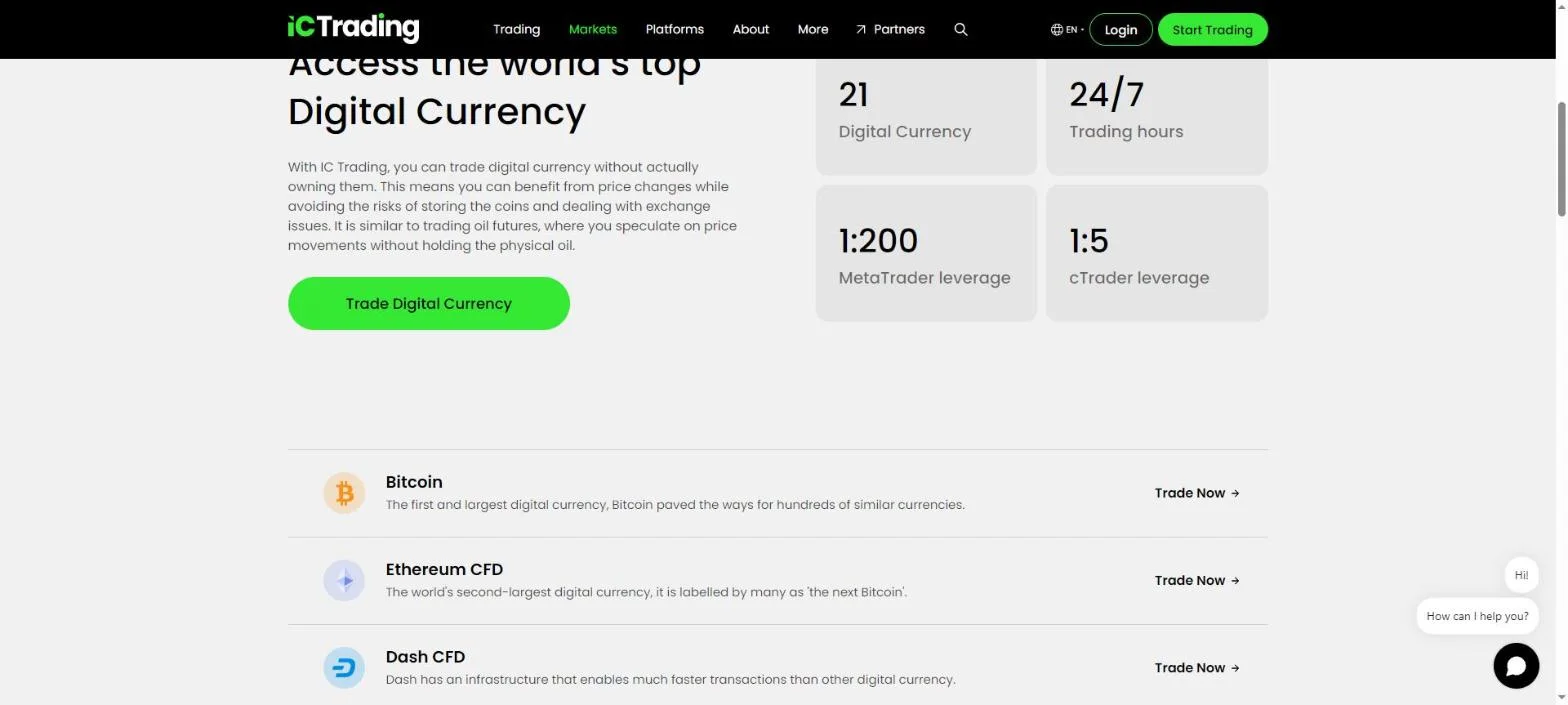
IC Trading advertises 21 crypto CFDs and two very different leverage caps on the same page.
Where it gets interesting is the spread table further down the same page. That one lists 18 symbols, not 21, and it is not a subset.
Six coins appear in the hours table but have no published spread: SOLUSD, MTCUSD, LUNUSD, KSMUSD, GLMUSD and AVXUSD. Solana is in that group, which is the one most crypto readers will notice.
Three coins appear in the spread table but not in the hours table: EMCUSD (Emercoin), NMCUSD (NameCoin) and PPCUSD (PeerCoin) — three legacy names that read like leftovers from an older symbol list.
Both tables are on IC Trading's own site and both are presented as current. This review records both rather than guessing which one is stale. The practical takeaway is simple and checkable: if you intend to trade one of those six, pull the live spread in the terminal before you size anything, because the public page does not quote it.
"24/7" is close, and the gap is on a Friday night
The marketing tile says 24/7 Trading hours. The table says something slightly more precise, and the difference is small but worth knowing if you run stops.
For every crypto symbol listed, the published session is: Monday to Thursday 00:05-23:59, Friday 00:05-23:55, Saturday 00:45-23:59, Sunday 00:05-23:59 (server time, which IC Trading sets to GMT+2, or GMT+3 during daylight saving).
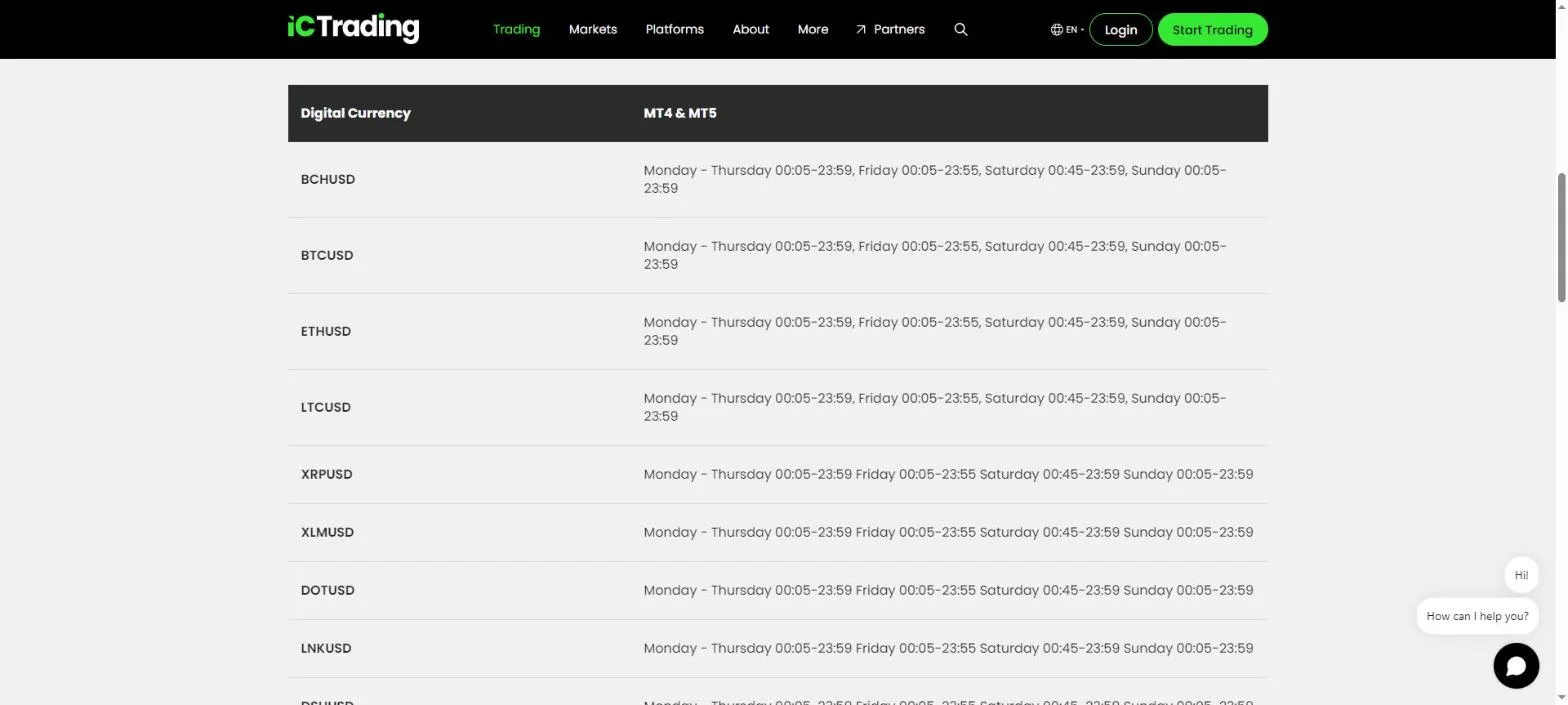
The published crypto sessions run through Saturday and Sunday, under a column headed MT4 and MT5.
Read that carefully and you get a six-minute daily break just before midnight, plus a longer gap after the Friday close: the market shuts at 23:55 on Friday and does not reopen until 00:45 on Saturday — roughly fifty minutes with no quote.
So "24/7" is a rounding, not a lie. The substantive point stands and it is the genuinely strong one: crypto CFDs here trade through the weekend, which no forex pair on the same platform does. If your thesis is that the news that moves Bitcoin does not respect the New York close, that is a real structural advantage over a forex-only account. Just do not assume a stop will be filled during the Friday-night gap.
The 40x difference nobody puts in the headline
This is the single most important line on the page for anyone sizing a position in IC Trading crypto CFDs, and it is easy to skim past.
IC Trading publishes two leverage figures for crypto, side by side:
1:200 — MetaTrader leverage
1:5 — cTrader leverage
That is a forty-fold difference in buying power on the same instrument at the same broker, decided entirely by which platform you signed up on. A USD 1,000 account controlling USD 200,000 of notional BTC on MT5 controls USD 5,000 on cTrader.
The trading-hours table points the same way: the crypto table has exactly one hours column, headed MT4 & MT5. cTrader is not given its own column there.
Neither number is "better" in the abstract. 1:5 is conservative and closer to what regulated venues in several jurisdictions permit on crypto; 1:200 is aggressive and will liquidate an under-margined account on an ordinary Bitcoin candle. What matters is that the platform choice, not the account type, is what decides your crypto capability here. Pick the platform for the leverage regime you actually want, and check it in your own terminal before the first trade — a published figure is a starting point, not a guarantee for your jurisdiction or account.
Spreads: the company's own numbers, and the gap inside them
IC Trading publishes minimum and average spreads for crypto, marked "All Accounts". These are the broker's figures, not independently measured, and the page does not say over what window the averages were taken.
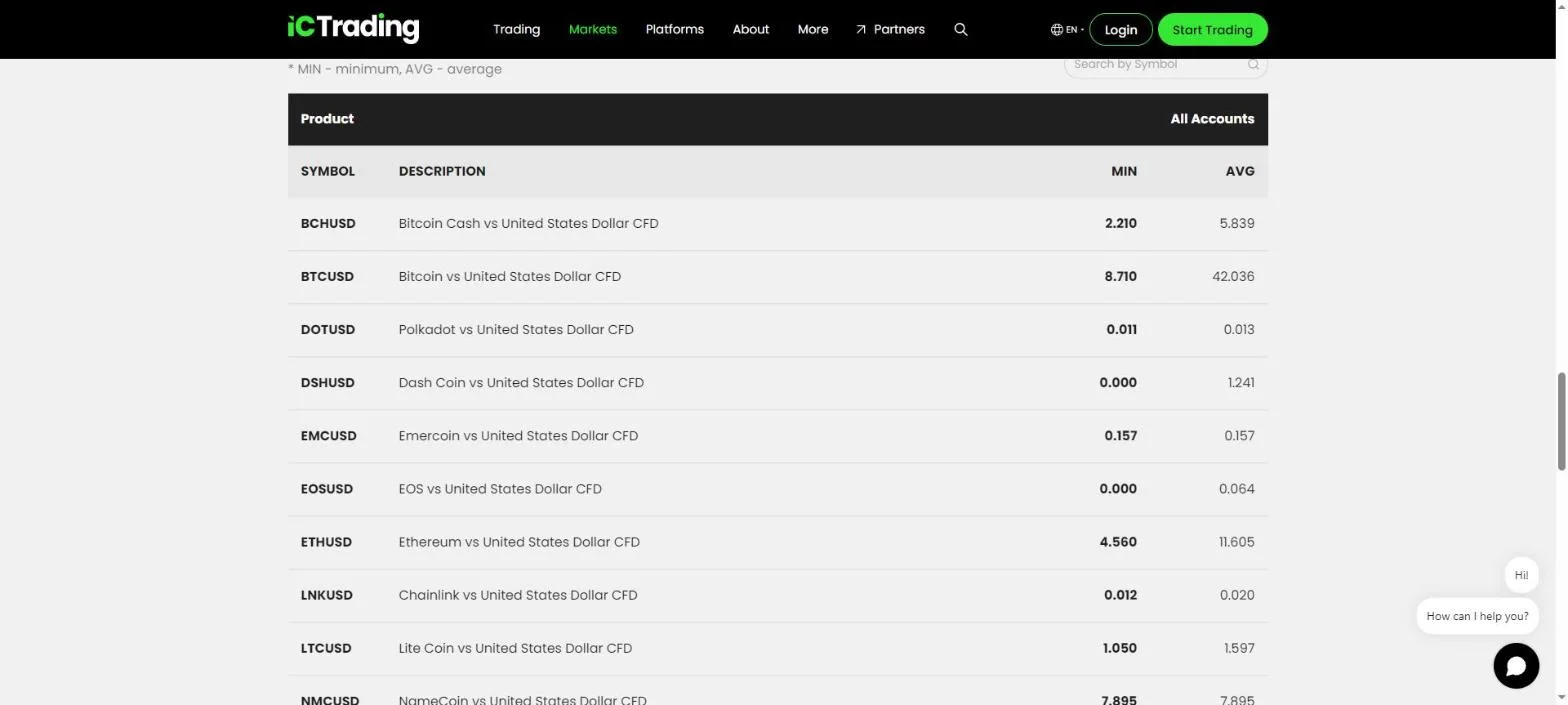
IC Trading publishes both a minimum and an average spread column. On Bitcoin the two are far apart.
A few of the headline rows:
BTCUSD (Bitcoin vs USD) — minimum 8.710, average 42.036
ETHUSD (Ethereum vs USD) — minimum 4.560, average 11.605
BCHUSD (Bitcoin Cash vs USD) — minimum 2.210, average 5.839
LTCUSD (Litecoin vs USD) — minimum 1.050, average 1.597
XRPUSD (Ripple vs USD) — minimum 0.008, average 0.020
DOGUSD (Doge vs USD) — minimum 0.001, average 0.001
XLMUSD (Stellar vs USD) — minimum 0.000, average 0.000
The useful thing here is not the minimum, it is the ratio. On BTCUSD the average is roughly 4.8 times the minimum (8.710 against 42.036); on ETHUSD it is about 2.5 times. On the small-cap pairs the two columns barely move apart at all.
Read that honestly and it tells you something true about crypto CFD pricing in general: the attractive number is the best case, not the typical one, and on Bitcoin specifically the typical case is several times worse than the advertised floor. Credit to IC Trading for publishing the average column at all — plenty of brokers show only the minimum and let you find out the rest live.
The full crypto spread table, including the symbols not covered above, is published on IC Trading’s Digital Currency page.
The crypto rails are the best part
For a reader who already lives on-chain, this is where IC Trading crypto CFDs separate themselves from a generic forex broker.
Funding. The deposit table lists a crypto option taking USDT, USDC, BTC and ETH, with a processing time of Instant - 2 hours. Cards and e-wallets (Skrill, Neteller, SticPay) are instant in major currencies; international bank transfer is 2-5 business days. There is also a local-payments rail covering VND, PHP, JPY, MYR and THB at Instant - 24 hours, which matters across Southeast Asia.
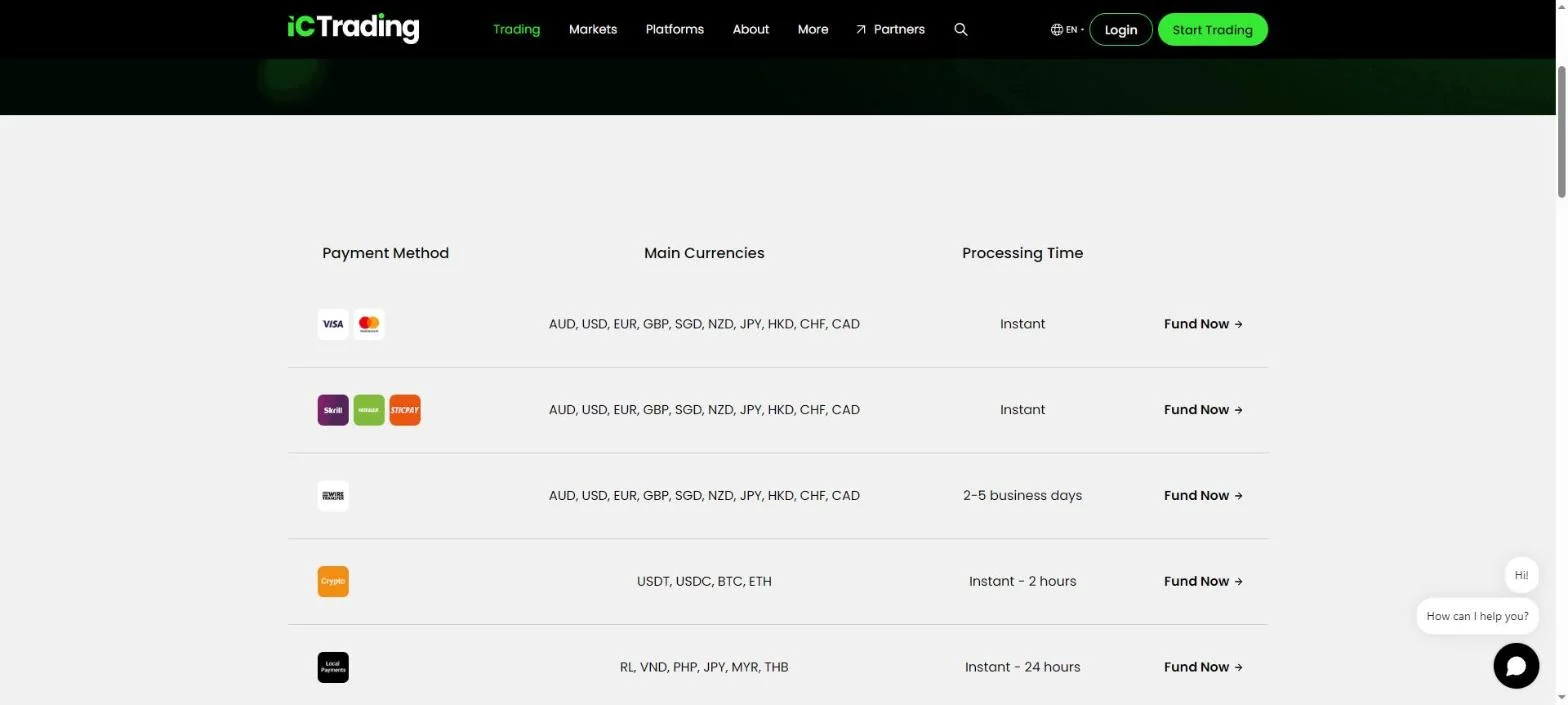
Crypto funding takes USDT, USDC, BTC and ETH, alongside local rails for VND, PHP, JPY, MYR and THB.
Fees. IC Trading states plainly: "We do not charge any additional fees for deposits" and, separately, "We do not charge any additional fees for withdrawals." The company notes that intermediary or international banking institutions may still charge you, and that those are the client's responsibility — which is accurate and standard.
Withdrawal. Crypto is the fastest route out as well as in. The policy says funds are credited to your online wallet or crypto wallet instantly once processed, and "in case of Crypto it may take up to 2 hours for the funds to be applied to your crypto wallet." Compare that with the bank-transfer line on the same page: local transfers 1-2 business days after processing, international transfers 2-14 business days. Card withdrawals come back as a refund of the deposit, typically 3-5 business days and up to 10 in rare cases, with anything above the original deposit needing a separate route.
So for a crypto-native user the round trip is stablecoin in, stablecoin out, no card refund mechanics, no SWIFT window, no bank statement for the first withdrawal (that requirement is specific to bank transfers).
The catch worth saying out loud. "Instant once processed" is doing real work in that sentence. Processing follows a business-day cut-off: withdrawal requests must be submitted by 06:00 MUT during the AEST period, or 05:00 MUT during AEDT, to be processed the same business day; anything later goes to the next business day.
Put that next to the weekend trading and you get the one genuine asymmetry in this product: the market stays open all weekend, but the withdrawal queue does not. Close a profitable Saturday position and the coins do not leave until the next business day's processing run. That is normal for every broker with a compliance function, and it is not hidden — it is on the same page as the fee policy. But if your mental model is an exchange where withdrawal is a 24/7 button, adjust it before you need the money on a Sunday.
The complete funding, fee and withdrawal policy — including the cut-off times quoted here — is set out on IC Trading’s official site.
About that Bitcoin example on the page
IC Trading includes a worked "Bitcoin CFD Trading Example" on the crypto page. It opens a position at 3910.25 and closes it a month later at 4200.50 on two contracts, for a gross profit of USD 580.50.
Two neutral observations for a reader deciding whether to trust the page as a teaching tool.
First, the prices are old. Bitcoin at 3910 is not a current reference point, and the live ticker at the top of the very same page was quoting BTCUSD around 81,000 when this review was written — itself a snapshot, not a figure to rely on. The example still demonstrates the arithmetic correctly; it is just not calibrated to today's contract sizes or margin.
Second, and more usefully: the example only shows a trade that wins. There is no mirrored example of the same position moving 290 points the other way, which at 1:200 on an under-funded account is the scenario that actually ends people. If you are new to CFDs, run the losing version of that calculation yourself before you fund anything. The maths is the same; only the sign changes.
Who holds the money, and the one word in the insurance line
This is the section that matters more than spreads.
Entity and licence. The crypto offering is provided by Capital Point Trading Ltd, which holds licence GB21026834 from the Financial Services Commission of Mauritius. That is a real, checkable registration — the FSC maintains a public register, and anyone can look the number up directly at the Financial Services Commission of Mauritius public register before depositing. Mauritius is a legitimate but mid-tier jurisdiction: it is not the FCA, ASIC or CySEC, and there is no statutory investor compensation scheme comparable to the FSCS behind it.
Client money insurance — read the preposition. IC Trading states that client funds are covered by an insurance policy, number TT2602110, up to US$1,000,000. The exact published wording is that the cover is up to one million dollars "for all claimants".
That phrase is the whole story. It describes an aggregate limit across everyone who claims, not a per-client limit. A million dollars shared among every affected client in an insolvency is a very different thing from a million dollars protecting your account. The cover is a genuine positive and most offshore brokers carry nothing like it — but it should be read as what it says, not as what a quick glance suggests.
Who cannot open an account. IC Trading does not accept clients from the USA, Canada, Israel, New Zealand, Iran or North Korea.
The risk warning, in the company's own words: "CFDs are complex instruments... The majority of retail investor accounts lose money when trading CFDs." That is IC Trading's published statement, and it matches the industry-wide regulatory data. Leverage of 1:200 on an asset that routinely moves 5% in a day is not a feature you grow into casually.
Who IC Trading crypto CFDs fit
It fits a trader who already holds crypto, wants weekend exposure without moving coins to a spot exchange, is comfortable funding and withdrawing in USDT or USDC, and wants crypto sitting in the same terminal as indices, metals and FX so one margin pool covers all of it. The Southeast Asian local-payment rails are a real convenience if you are in Vietnam, the Philippines, Malaysia or Thailand.
It fits less well if you want to own the asset — these are CFDs, there are no keys and no on-chain settlement; if you need a top-tier regulator and a statutory compensation scheme; if you trade mainly Solana, Polygon, Avalanche, Kusama, Golem or Luna and want a published spread before you commit; or if you need money out on a weekend.
How this review was done
This is a desk review. All figures above were read directly from IC Trading's own published pages on 15 October 2026 — the Digital Currency markets page, the Trading Hours table, the published spread table, the Funding and Withdrawals page, and the Regulations and Insurance pages. Screenshots are included so you can check each claim against the source.
No live account was opened and no trade was placed for this article, so nothing here is a measurement of real execution, slippage or withdrawal speed. Spreads, leverage caps, available symbols and payment methods are the company's own statements and can change without notice, and may differ by jurisdiction and account type. Where two of IC Trading's own pages disagreed — the 21-symbol hours table against the 18-symbol spread table — both are reported as published rather than reconciled.
Nothing in this article is investment advice or a recommendation to trade. CFDs are leveraged products and most retail accounts lose money on them.
IC Trading crypto CFDs: the verdict
Judged as what they are — a crypto sleeve inside a multi-asset CFD broker, not a replacement for an exchange — IC Trading crypto CFDs are a strong offering. Twenty-one coins, genuine weekend sessions, stablecoin in and out with no broker-side fee, published average spreads alongside the minimums, a verifiable FSC Mauritius licence and a seven-figure insurance policy add up to a serious product rather than a token crypto tab.
The things to go in knowing are all checkable before you deposit: the leverage you get depends entirely on whether you choose MetaTrader or cTrader, six of the twenty-one coins have no published spread, the average Bitcoin spread is several times the advertised minimum, the insurance limit is aggregate rather than per client, and the withdrawal queue observes business days even though the market does not.
Check each of those against the source pages, size accordingly, and treat the published numbers as the company's claims rather than independent measurements.
If IC Trading crypto CFDs look like a fit for how you already trade, start with the source pages: open the official IC Trading site, check the six points above against them, and size from there.