Trezor vs Ledger in 2026: Open Chips, Closed Chips, and Two Leaked Address Books
The Trezor vs Ledger argument is usually fought over secure elements. In 2026 the more useful question is which company can keep your home address off a criminal list — and neither one managed it.
Ask which hardware wallet to buy and Trezor vs Ledger is where the conversation lands, usually with the same two arguments: Trezor is open source, Ledger has certified secure elements. Both statements are true. Neither is the thing that will actually get somebody's coins taken in 2026.
This comparison starts with the specifications, because they matter, and then moves to the part both companies would rather you skimmed: what happened to their customer databases, and what that means in a category where every published attack on either device begins with somebody physically holding it.
A note on incentives before anything else. This article contains affiliate links to Trezor and none to Ledger, because Trezor runs the programme we are in. That is a reason to read the Ledger sections sceptically, so we have tried to make them the strongest case for Ledger we can support with sources. Judge the argument, not the link.
The price ladders, side by side
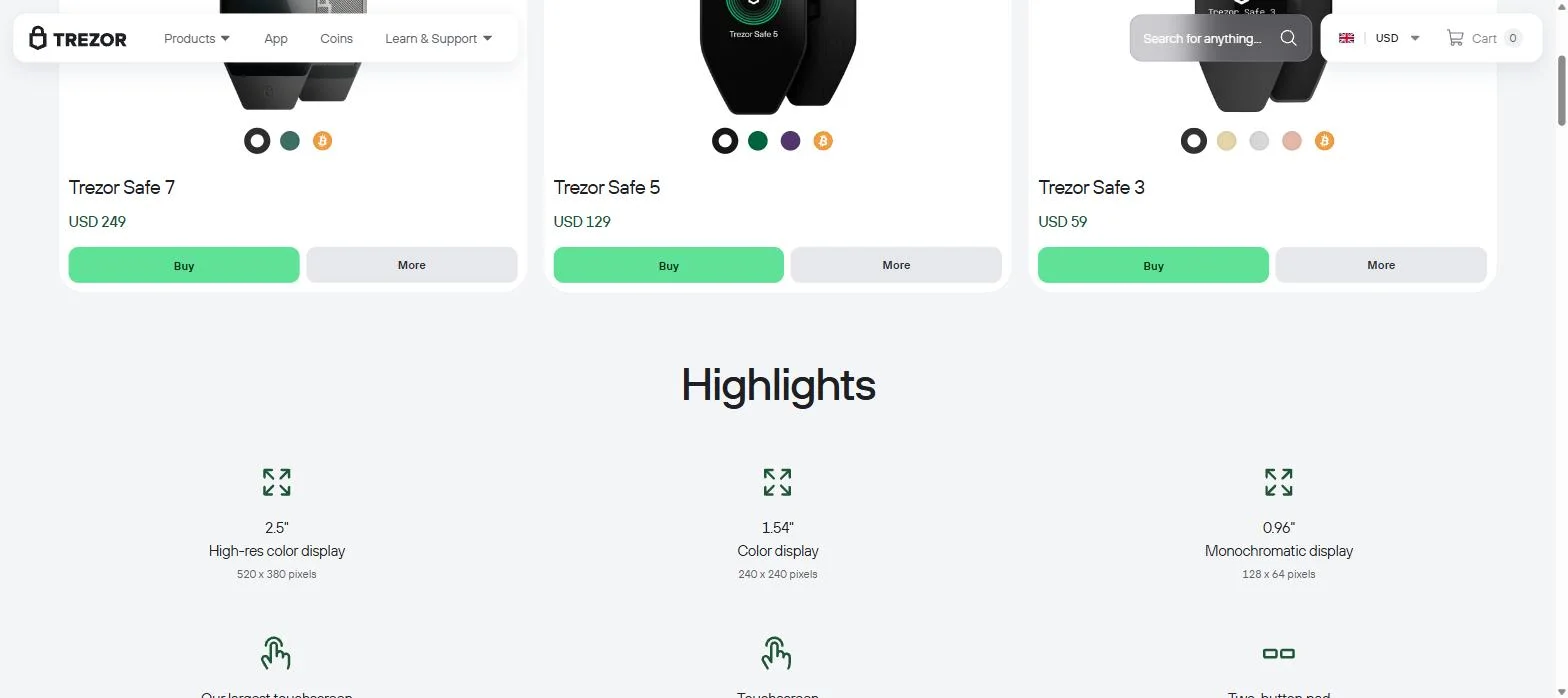
Entry: Trezor Safe 3 at USD 59 · Ledger Nano S Plus at USD 59
Mid: Trezor Safe 5 at USD 129 · Ledger Nano X at USD 99
Upper mid: no Trezor equivalent · Ledger Nano Gen5 at USD 179
Flagship: Trezor Safe 7 at USD 249 · Ledger Flex at USD 249
Premium: no Trezor equivalent · Ledger Stax at USD 399
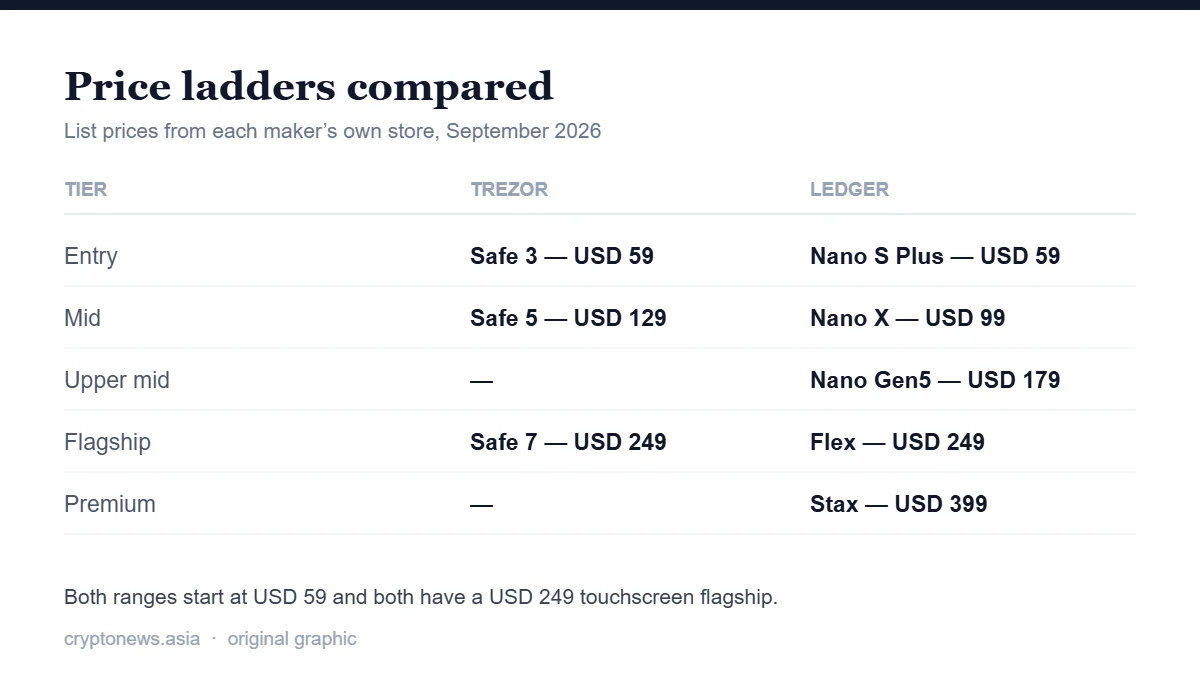
The ladders match more closely than the tribal arguments suggest, and the Trezor figures come from its own store. Both brands start at exactly USD 59. Both have a USD 249 touchscreen flagship. Ledger has more rungs and reaches higher; Trezor's range is three devices plus Bitcoin-only firmware editions at the same price, which is a real if quiet advantage, because less code in the firmware is less to attack.
For a Trezor vs Ledger buyer that symmetry is worth noticing: at both ends of the range you are choosing a philosophy, not a price. And the specification difference that matters most is not the screen. It is what is inside, and who is allowed to look at it.
Open chips versus certified chips
Ledger's position has been consistent for a decade: use bank-grade secure elements certified to Common Criteria EAL5+ or EAL6+, and accept that the chip vendor's code is under NDA. You cannot inspect it. You are trusting the certification and the vendor.
Trezor's position was long the opposite and arguably worse: fully open firmware, but early devices had no secure element at all. The Safe line changed that, and the Safe 7 goes further with TROPIC01, which Trezor calls the world's first auditable secure element. That claim holds up. It is a secure element whose design is open to inspection, which is a genuine first in a category built on sealed chips.
So the honest framing of Trezor vs Ledger on architecture is not secure versus insecure. It is this: do you want a chip that a certification body has examined and you cannot, or a chip anyone can examine and that consequently has published flaws?
Because it does have published flaws. That is the trade.
Who audits whom
Here is the part that makes the comparison genuinely awkward, and it cuts both ways.
Ledger's Donjon security team has repeatedly broken Trezor devices and published the results. In March 2025 it bypassed the firmware integrity check on the Trezor Safe 3 through voltage glitching after desoldering the microcontroller. In June 2026 it used laser fault injection against the Safe 7's TROPIC01 chip to extract one of three secrets protecting the PIN. Both were disclosed responsibly, and in both cases Trezor confirmed that private keys and wallet backups were not extracted, because other layers held.
That is the Trezor vs Ledger paradox in one paragraph: the company being broken in public is the one letting you watch. Both findings were also unfixable by firmware. Asked directly whether a firmware update resolved the Safe 3 issue, Trezor answered: "Unfortunately not."
Now the awkward half. Every one of those findings exists because Trezor's designs can be studied. There is no equivalent public catalogue of attacks on current Ledger devices, and the reason is not established to be that they are unbreakable. It is that the chips are under NDA and the secure element firmware is not open. Absence of published flaws in a closed system is absence of publication, not proof of absence.
That is not an accusation against Ledger. Its devices have a long field record and no demonstrated key extraction on current models. It is a statement about what each buyer can actually verify. If verification matters to you, that asymmetry is the whole argument.
What Ledger Recover revealed
In 2023 Ledger announced Recover, and the reaction was severe enough that it is still the first thing many people say about the brand.
Read Ledger's own description of how it works. Your recovery phrase is "created, encrypted, split into three within your Ledger's Secure Element", and the three encrypted fragments are then held by independent companies in different countries inside hardware security modules, each fragment tied to an identity document you upload. It is opt-in, it is a paid subscription, and it is operated with Coincover.
Nothing in that is a vulnerability. Everything in it is properly encrypted, and nobody is forced to use it.
The reason it mattered is architectural. A large number of users believed that seed material physically could not leave a Ledger's secure element under any circumstances. Recover demonstrated that firmware could be written which exports encrypted fragments of it. That was always true of a device that accepts signed firmware updates from its manufacturer. Recover simply made it visible.
The fair conclusion is not that Ledger is unsafe. It is that on both brands you are trusting a firmware signing key, and on Trezor you can at least read the firmware that key signs.
The part where both companies failed
Now the section that changes the practical answer, and the reason this comparison was worth writing in 2026 rather than 2023.
Every attack described above needs an adversary to physically hold your device. Lab equipment, decapsulated chips, repeated power cycles. The prerequisite is always the same: they found you.
Both companies have leaked the information that helps somebody find you.
Ledger, June 2020. An e-commerce database breach exposed over 1.1 million email addresses, and for roughly 292,000 customers the names, phone numbers and physical addresses as well. The data was sold, then dumped publicly in December 2020. What followed was not theoretical: waves of phishing, extortion messages, and threats against people at their homes.
Ledger, January 2026. Again through a third party, the payment processor Global-e. Customer names and contact details were exposed. Payment cards, passwords, recovery phrases and private keys were not.
Trezor, August 2026. Through ShipMonk, its fulfilment partner. Trezor's own disclosure puts it at 80,689 customers: names, emails, phone numbers, shipping addresses and order numbers. Keys and backups untouched.
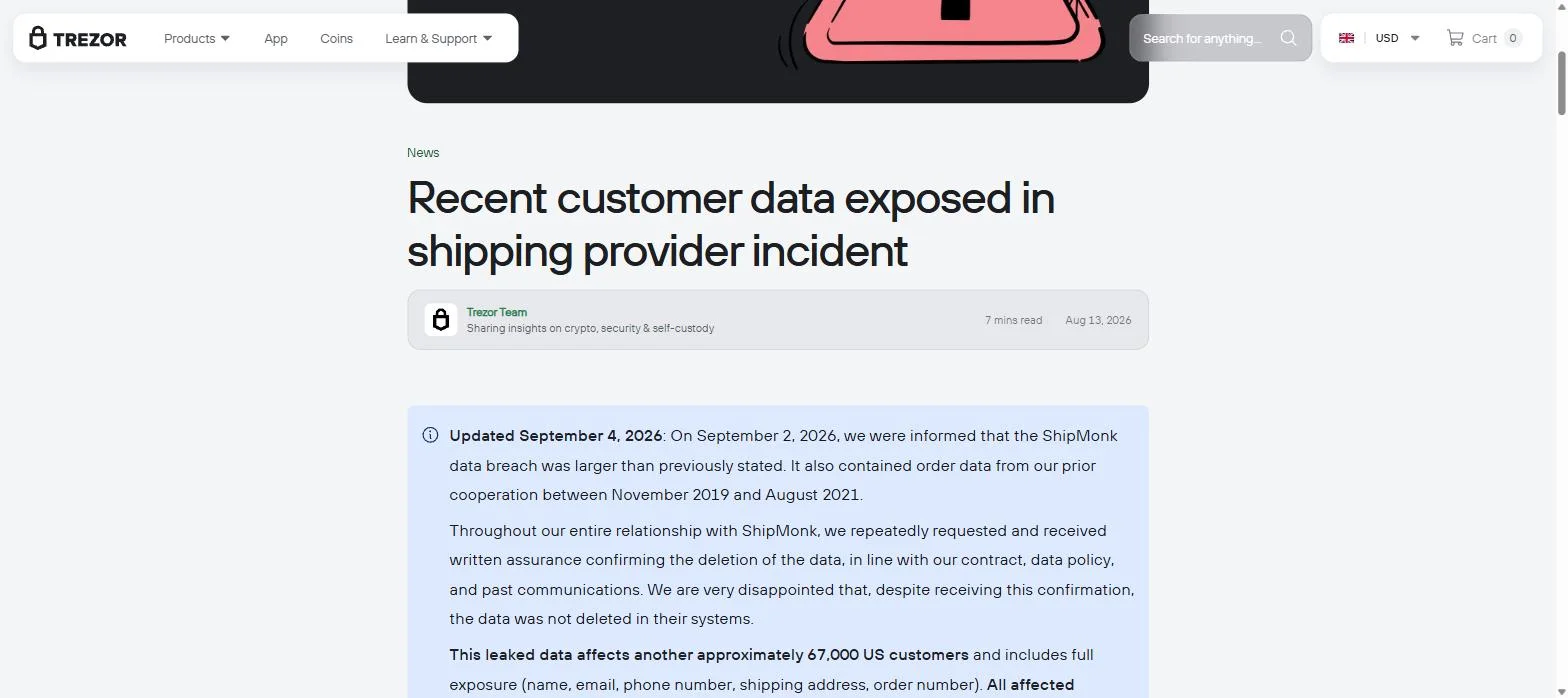
The update of 4 September 2026 is worse than the original notice, because the leaked set included order data from a cooperation that ended in 2021, data that should not have existed any more. In Trezor's own words, it "repeatedly requested and received written assurance confirming the deletion of the data", and is "very disappointed that, despite receiving this confirmation, the data was not deleted in their systems."
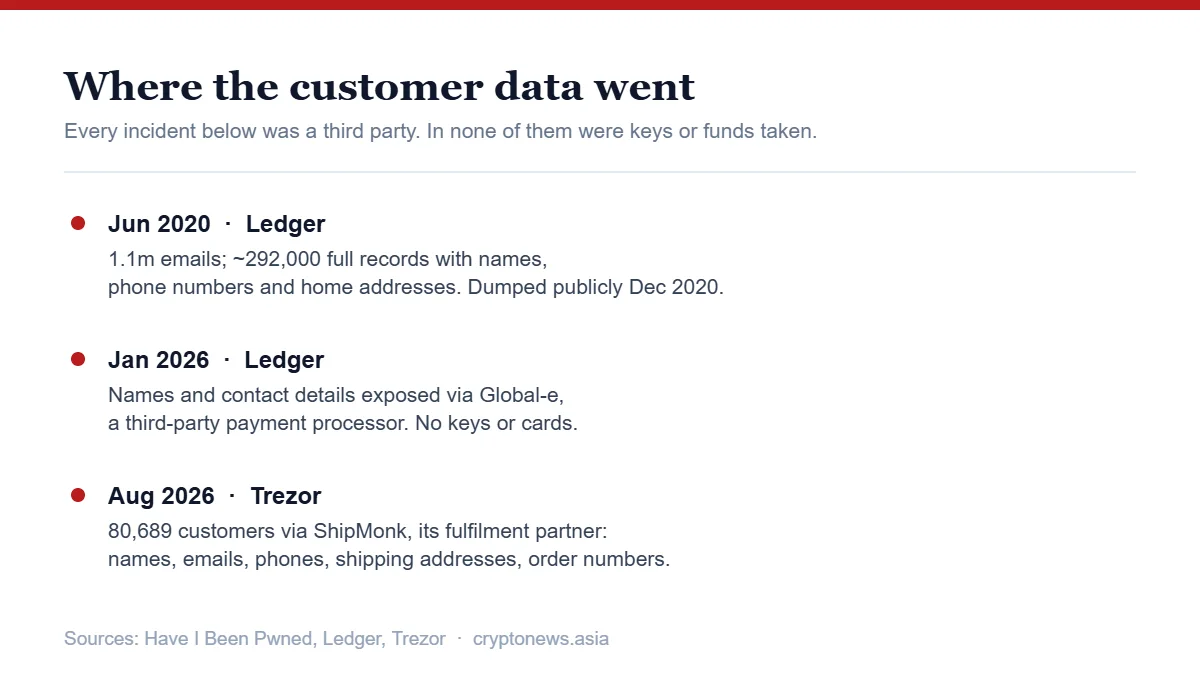
Line those up and the Trezor vs Ledger scoreboard on chips stops looking like the important one. Two companies whose entire product exists to protect people from physical compromise have, between them, put the home addresses of hundreds of thousands of known crypto owners into circulation. In every case it was a third party, and in every case the promise that the data was safe turned out to be a promise on paper.
So which should you buy?
Buy Trezor if verification is the point. Open firmware, an auditable secure element on the Safe 7, Bitcoin-only firmware at no extra cost, and a company that publishes what researchers find rather than waiting for them to. You are accepting a device with a public list of physical attacks against it, all of which a passphrase defeats. If that is your reasoning, the current Trezor range and pricing is the place to start.
Buy Ledger if the ecosystem is the point. More models, a wider price range, mature apps, broad third-party integration, NFC and Bluetooth across more of the line, and certified secure elements with a long unbroken field record. You are accepting that you cannot inspect the chip or its firmware, and that you are trusting certification instead. Our Ledger Flex review and Ledger Nano S Plus review cover those devices individually.
Buy neither yet if you have not solved the backup. More people lose crypto to a lost or illegible seed phrase than to any attack in this article. Read how to set up a self-custody wallet responsibly first.
And if your threat model is genuinely physical — you are known to hold, or you live somewhere that matters — the Trezor vs Ledger question is less important than a QR-based air-gapped device such as the Keystone 3 Pro, a passphrase, and a delivery address that is not your home.
The four things that actually protect you
Set a passphrase. It defeats every physical attack published against either brand. Neither company can help you if you lose it, which is exactly the point.
Buy direct. From Trezor's own store or Ledger's, never a marketplace listing. Supply-chain tampering is the only attack here that needs no laboratory.
Put the seed on steel, not paper. This is the failure that actually happens to people.
Do not ship to your home, and use a dedicated email. Both companies have now proven they cannot guarantee that record stays private. It is the cheapest security upgrade in this article and it costs nothing.
Bottom line
On hardware, Trezor vs Ledger in 2026 is a close and honest tie, decided by temperament: open and inspectable with published flaws, or closed and certified with flaws nobody outside can look for. Trezor's transparency is the better philosophy and it produces the uglier headlines. Ledger's certification is the safer-sounding claim and it produces the quieter ones. Both make devices that will protect ordinary users from ordinary threats.
On operational security, neither has earned a good grade. The most useful thing this comparison can tell you is not which chip to trust. It is that in a category where every attack starts with somebody knowing where you live, both of the two biggest names have already let that slip, and the fix is on your side of the transaction rather than theirs. Check the current Trezor lineup here, buy from the official store, and think about where the parcel goes.
Disclosure: this article contains affiliate links to Trezor. If you buy through them we may earn a commission at no additional cost to you. There are no Ledger affiliate links here, and the criticisms of both brands stand regardless.