Fomo Review 2026: The Cross-Chain App Most of Asia Can Use, Its Solana Fee Bands and Its Missing Rails
Fomo routes spot trades across six chains from a phone, needs no KYC and is legal across most of Asia — yet no Asian market is among its top five traffic sources. We look at the fee bands, the regional limits and how it compares with Axiom.
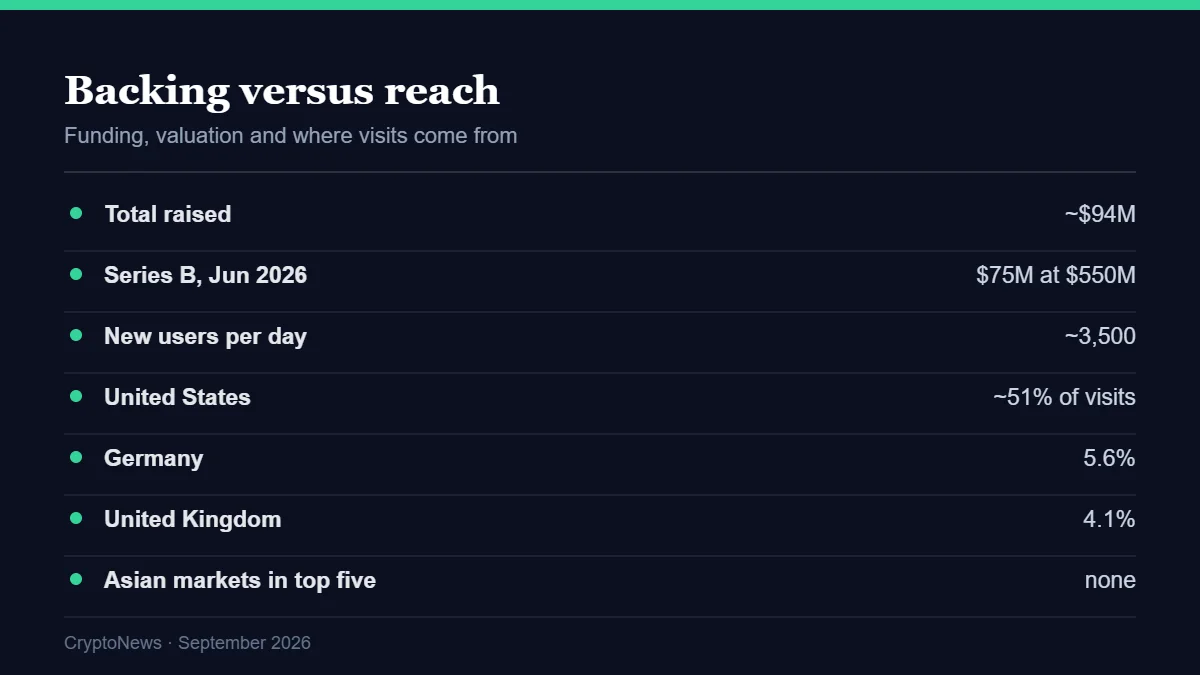
Fomo is a mobile-first crypto trading app that routes spot orders across Solana, Base, BNB Chain, Ethereum, Monad and Robinhood Chain from one screen, with a social feed and leaderboard attached. It has raised about $94 million, was valued at $550 million in June 2026, and was onboarding roughly 3,500 users a day at the time of that round. It is also open to almost every country in Asia — and almost nobody in Asia is using it. This review covers what the product does, what it charges, who it locks out, and how it compares with Axiom, the Solana terminal we reviewed in September.
What Fomo is
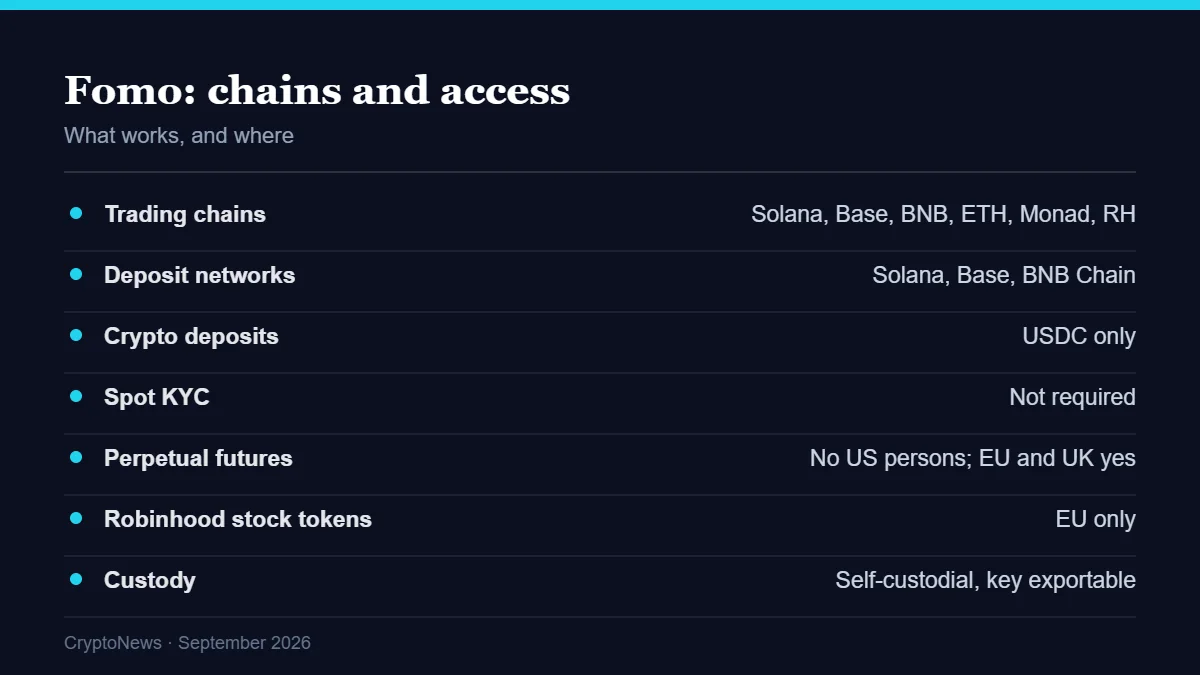
Fomo is built by FOMO Labs, Inc., a New York company founded by Paul Erlanger and Se Yong Park and launched in May 2025. The app is self-custodial: the private key is split using Shamir's Secret Sharing, provisioned through Privy, and reassembled only inside a secure enclave to sign a transaction. There is no seed phrase to write down — you sign in with Apple ID or Google — and the key can be exported, protected by FaceID, which is the feature that makes the self-custody claim real rather than rhetorical.
The pitch is one interface across chains without bridging. You fund with a debit card, Apple Pay or a USDC transfer, and buy tokens on any supported chain in one tap. The social layer shows what people you follow are buying, with a leaderboard ranking traders by performance. Fomo is not registered with or licensed by any regulatory authority, and says so in its own terms; there is no FDIC or SIPC protection, because self-custody sits outside what those schemes cover.
Who in Asia can actually use it
For a regional audience this is the part that matters, and the answer is more open than most people assume. Fomo's restricted list names Iran, Yemen, Myanmar, North Korea, the Democratic Republic of Congo, Libya, Sudan, Cuba, Venezuela and the occupied Crimea, Donetsk and Luhansk regions, plus a catch-all for any jurisdiction under US, UK or EU sanctions or where crypto transactions are prohibited outright.
In Asia, only North Korea and Myanmar are named. Everywhere else in the region falls under the catch-all, which means local law decides. Spot trading requires no KYC, so the practical barrier for most Asian users is not identity verification but fiat rails and local legality.
Spot trading: available in the US and most unrestricted regions, no KYC required.
Perpetual futures: closed to all US persons; available in the EU and UK.
Robinhood stock tokens: restricted in the US, Canada, UK and Switzerland; available across the rest of the EU.
Bank withdrawals: Fomo states plainly that withdrawals to bank accounts are not supported in all regions. Check yours before funding anything.
VPNs to get around any of the above are an explicit breach of the terms.
You can check what the app offers from your own region before depositing, since the account itself costs nothing to open.
What it charges
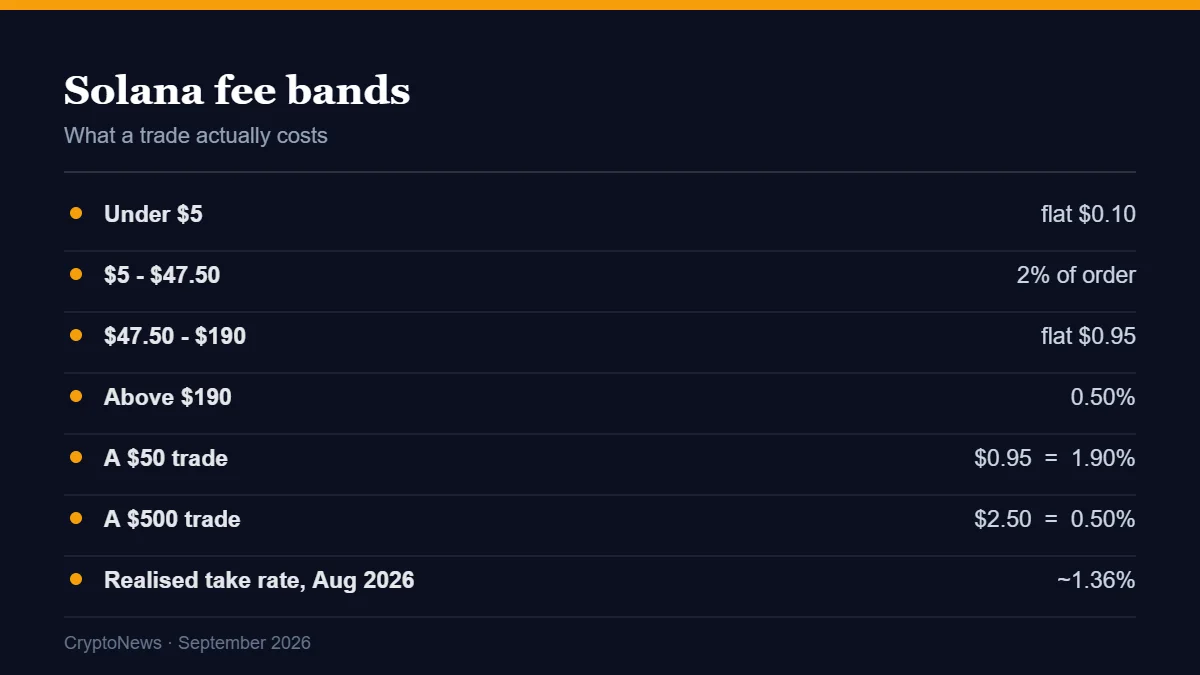
Fomo charges a flat 0.50% per trade on Base, BNB Chain, Monad and Robinhood Chain, and 0.50% plus network fees on Ethereum. Solana — where most of the app's memecoin activity sits — is tiered, and the tiers are where the advertised rate stops being true:
Under $5: a flat $0.10
$5 to $47.50: 2% of the order
$47.50 to $190: a flat $0.95
Above $190: 0.50%, the headline rate
A $50 Solana trade therefore costs $0.95, or 1.90%. A $100 trade costs the same $0.95, so 0.95%. Only above about $190 does the marketing number apply. DefiLlama data from August 2026 put the realised take rate across actual volume near 1.36%, which says most trades on the platform are small ones landing in the expensive bands. Perpetuals are cheaper at 0.05% per transaction on Fomo's side, with the venue's own fee — Hyperliquid's taker rate is 0.045% — on top.
A referral code applied at signup permanently cuts the standard rate by 10%, taking 0.50% to 0.45%. It cannot be added to an existing account afterwards, which makes it the one genuinely time-sensitive decision in the onboarding. Fomo pays referrers a share of their invitees' fees, and the links in this article are referral links — weigh the review accordingly.
Where the users and the money actually are
Fomo's funding history is unusually strong for a two-year-old consumer app. An initial round came from roughly 140 angel investors including Raj Gokal of Solana, Marc Boiron of Polygon Labs and Balaji Srinivasan. Benchmark led a $17 million Series A in November 2025, a rare crypto position for that firm. In June 2026, Index Ventures and Union Square Ventures led a $75 million Series B at a $550 million post-money valuation, with Mark Pincus and Kevin Hartz participating.
The traffic tells a different story from the cap table. The United States accounts for roughly 51% of visits, followed by Germany at 5.6%, the UK at 4.1%, Canada at 3.7% and Australia at 3.5%. No Asian market appears in that group. For a product that is legally usable across most of the region and requires no KYC to trade spot, that is a distribution gap rather than a regulatory one — and it is the single most interesting thing about Fomo from an Asian desk.
Fomo against Axiom
The closest comparison for readers here is Axiom Trade, which we reviewed earlier this month. The two products solve overlapping problems from opposite directions.
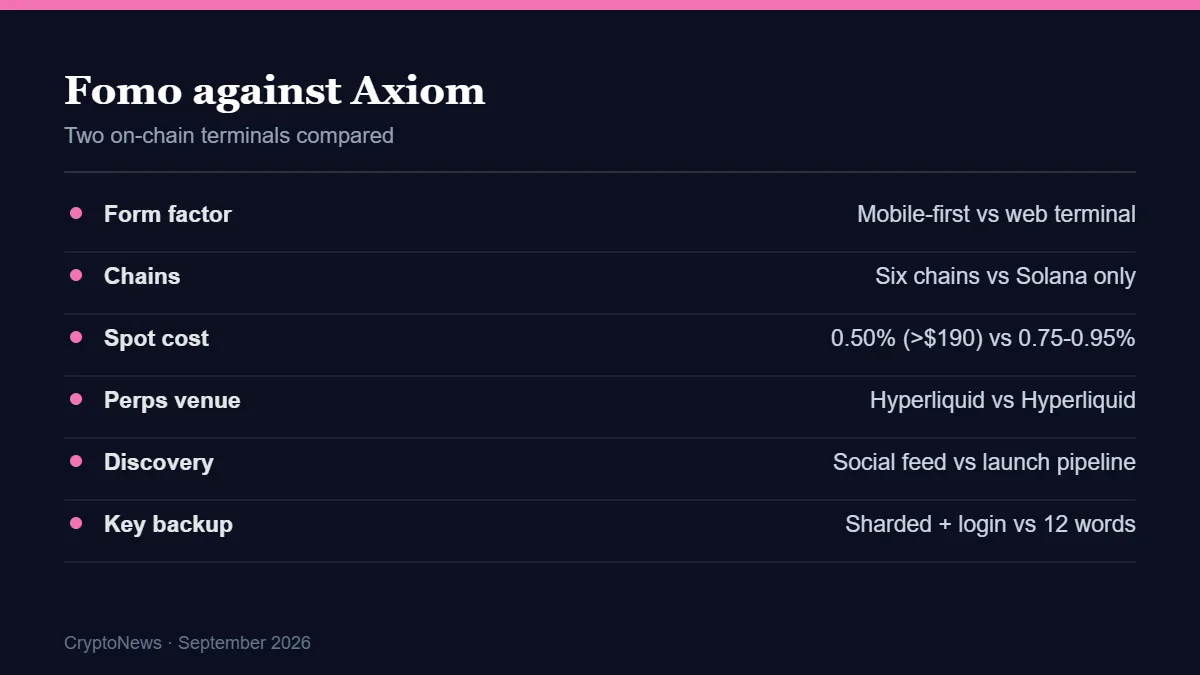
Form factor: Fomo is mobile-first with a web platform; Axiom is a web terminal built for a desktop workflow.
Chains: Fomo routes across six chains without bridging; Axiom is Solana-only.
Spot cost: Fomo is 0.50% above $190 on Solana and worse below it; Axiom runs 0.75% to 0.95% tiered by volume with partial SOL cashback.
Perps: both route to Hyperliquid; Axiom exposes up to 50x leverage inside its own interface.
Discovery: Axiom's Pulse feed is a launch pipeline for brand-new tokens; Fomo's feed is social, showing what other traders hold.
Custody: both non-custodial with exportable keys; Axiom uses a conventional 12-word seed phrase, Fomo uses sharded keys with login-based recovery.
Neither is a safe product in the sense a regulated broker is. Axiom carries a 2026 allegation that an employee misused internal tools to access user data; Fomo carries thin public documentation of what happens when you lose the device your account recovers through. If you want to compare them directly, you can open the Fomo feed and fee display without funding an account.
What is missing
Four gaps are worth naming, because they are the ones an Asian trader will hit first.
Fiat rails. Card and Apple Pay deposits work broadly, but bank withdrawal coverage is regional and undocumented country by country. If cashing out locally is the point, verify before you fund.
USDC-only crypto deposits. Sending the wrong asset or using the wrong network is the classic way to lose funds permanently, and no support team can reverse it.
Support. Email only, no live chat, with slow response times reported consistently across independent reviews. On a self-custody product that matters less than on an exchange, but it matters at 2am.
Hardware wallets. There is no Ledger or Trezor integration. Fomo is a hot wallet and should hold a trading balance, not a savings balance.
The recurring user complaint — that sells fail while buys go through — is usually thin liquidity on a freshly launched token rather than the wallet failing. That distinction matters technically and not at all emotionally: the app makes buying such tokens effortless and does not make the exit risk equally visible. Trustpilot shows 2.3 out of 5, but from six reviews on a profile the platform itself flags as possibly unrepresentative; the App Store figure of 4.8 from about 16,000 ratings is the better-powered number, skewed toward users currently winning.
Verdict
Fomo is a well-engineered, seriously funded product with a custody model better than most app-based trading and a fee structure that is transparent at the point of trade and misleading in the headline. It is legally available across most of Asia, needs no KYC for spot, and has almost no users in the region — which makes it either an opportunity or a warning, depending on whether you think the distribution gap is a marketing failure or a signal about fiat rails.
Rated for execution it is strong; rated for suitability to an inexperienced trader it is not. If you try it, keep only a trading balance on it, secure the email or Apple ID your account recovers through, export the private key once so you know the escape hatch works, and apply a referral code at signup because the permanent 10% fee cut cannot be added later. You can create an account with the fee discount applied or read the current fee schedule first.