Trezor Safe 7 Review: An Auditable Secure Element and the Flaw Found Inside It
Trezor's USD 249 flagship introduces the first auditable secure element and post-quantum firmware signing. It also carries a hardware-level chip flaw that firmware cannot patch. Here is what that means for your keys.
The Trezor Safe 7 is the company's flagship hardware wallet, listed at USD 249 on the official Trezor store. It is a considerable step up from the Safe 5 at USD 129, and that USD 120 gap is the question this review has to answer.
What the Trezor Safe 7 actually is
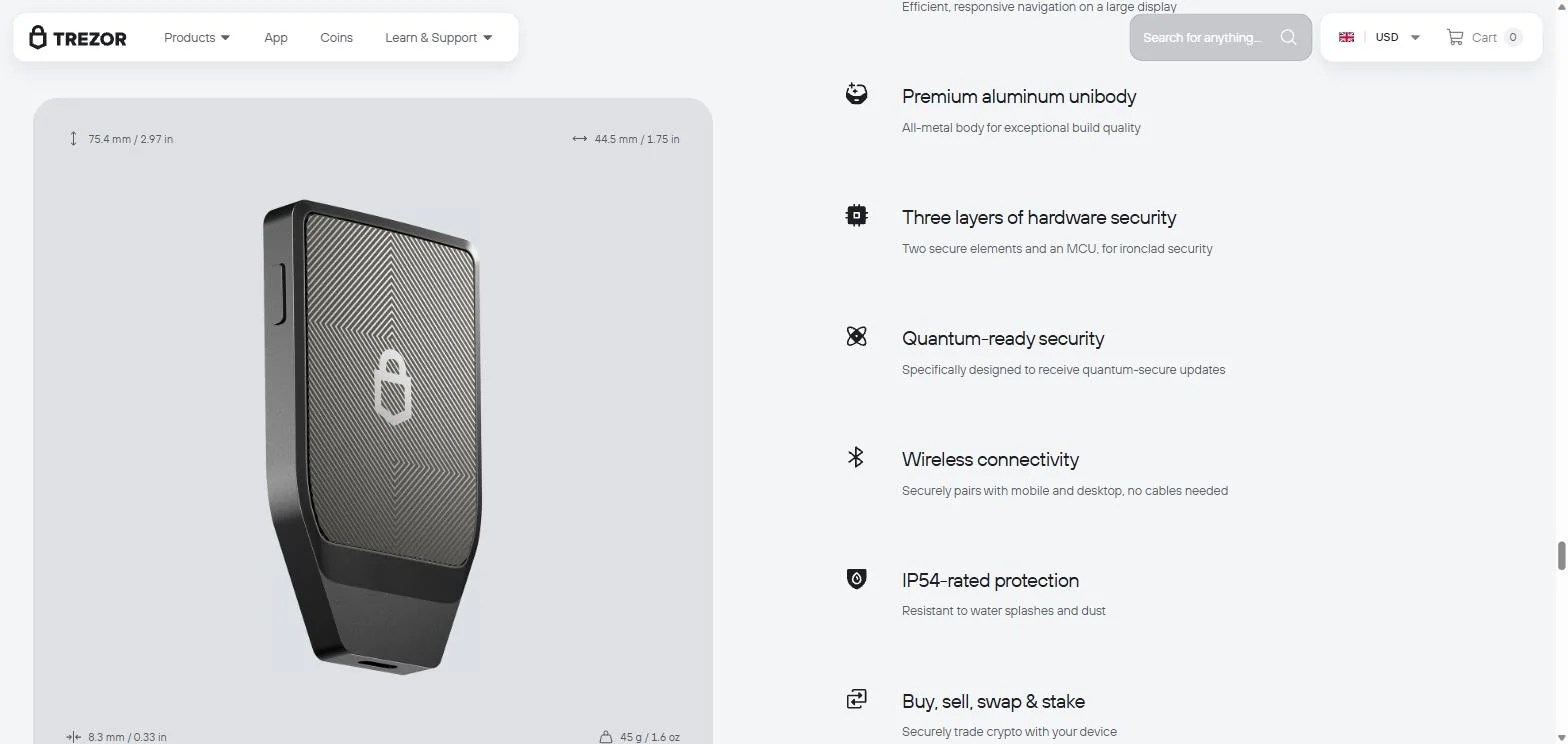
The money buys a 2.5-inch 520 x 380 colour touchscreen rated at 700 nits behind Gorilla Glass, a machine-anodised aluminium unibody with IP54 splash and dust resistance, encrypted Bluetooth, Qi2 wireless charging and an internal LiFePO4 battery. The device measures 75.4 x 44.5 x 8.3 mm and weighs 45 g.
Those are the specifications Trezor publishes, and they are accurate as far as they go. But a hardware wallet is not bought for its screen, and the two claims carrying the marketing, an auditable secure element and quantum readiness, both need unpacking before the price makes sense.
Three chips, three vendors, and one that is open
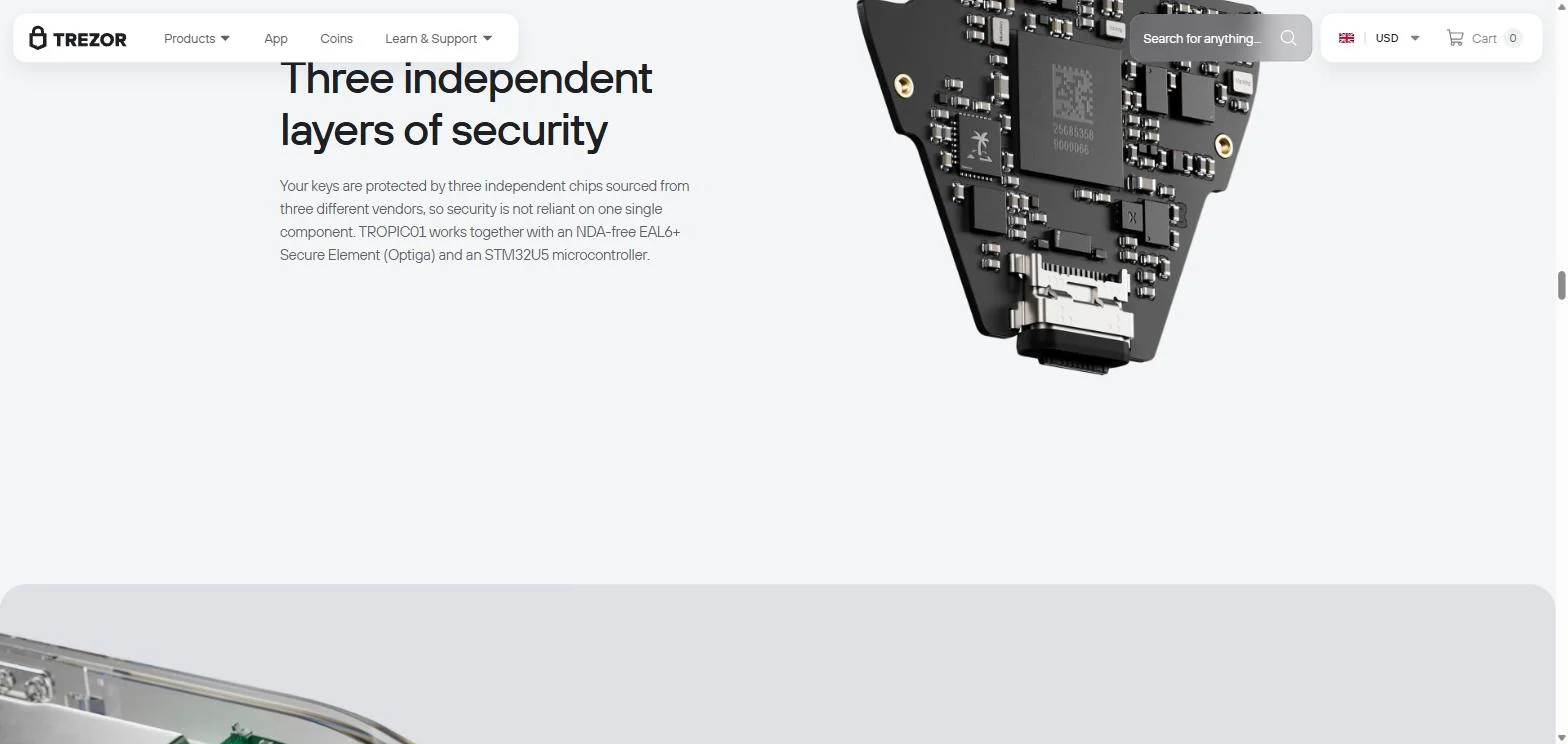
The headline engineering decision is that the Safe 7 does not rest on a single secure element. Trezor's page states that keys are protected by three independent chips sourced from three different vendors: TROPIC01, an NDA-free EAL6+ Optiga secure element, and an STM32U5 microcontroller.
TROPIC01 is the genuinely new part. Trezor describes it as the world's first auditable secure element, and that claim holds up in a way most hardware-wallet marketing does not. Conventional secure elements ship under non-disclosure agreements, so nobody outside the vendor can inspect what the chip does with a key. TROPIC01's design is open to inspection. For an industry whose entire pitch is do not trust, verify, that is a real advance, and the wider security community has broadly said so.
The layered design also matters more than it might appear, for reasons that became concrete a few months after launch.
The TROPIC01 disclosure: what happened
In late January 2026, Ledger's Donjon security research team found that a laser fault-injection attack could bypass firmware verification on the TROPIC01 chip, allowing an attacker to run custom firmware and extract secrets tied to device authenticity and PIN encryption. The finding went to Tropic Square, then to Trezor, and was disclosed publicly on 3 June 2026.
Three things about this are worth stating plainly, because they are easy to get wrong in either direction.
First, it is not remote. The attack requires physical possession of the device, disassembly, desoldering, backside decapsulation of the chip, specialised laboratory equipment and chip-level expertise, and it must be re-executed at every power-up. This is not a threat to somebody whose wallet is in a drawer.
Second, it is not nothing. Trezor's own write-up confirms the attack extracts one of three secrets protecting PIN encryption and can pull attestation material used in authenticity checks. Trezor's position, that the PIN remains protected by the Optiga and STM32U5 layers, that wallet backup generation and private keys are unaffected, and that funds remain safe, is the layered architecture doing exactly the job it was designed for. CEO Matej Zak's public line was that a vulnerability in TROPIC01 does not put user funds at risk.
Third, and this is the part buyers should weigh: it is a hardware-level flaw and cannot be fixed by a firmware update. Tropic Square is addressing it in the next generation of the chip. Every Trezor Safe 7 currently on sale carries it.
That does not make the device unsafe for ordinary use. It does mean the auditable secure element is, at present, an auditable secure element with a published defect, which is arguably the open-source model working as intended, since the flaw was found and disclosed rather than sitting undiscovered under an NDA. It also means the threat model that changes is the one involving physical device seizure. An evil-maid or border-seizure scenario is meaningfully different from an attacker who has never touched your hardware.
Quantum-ready needs a footnote
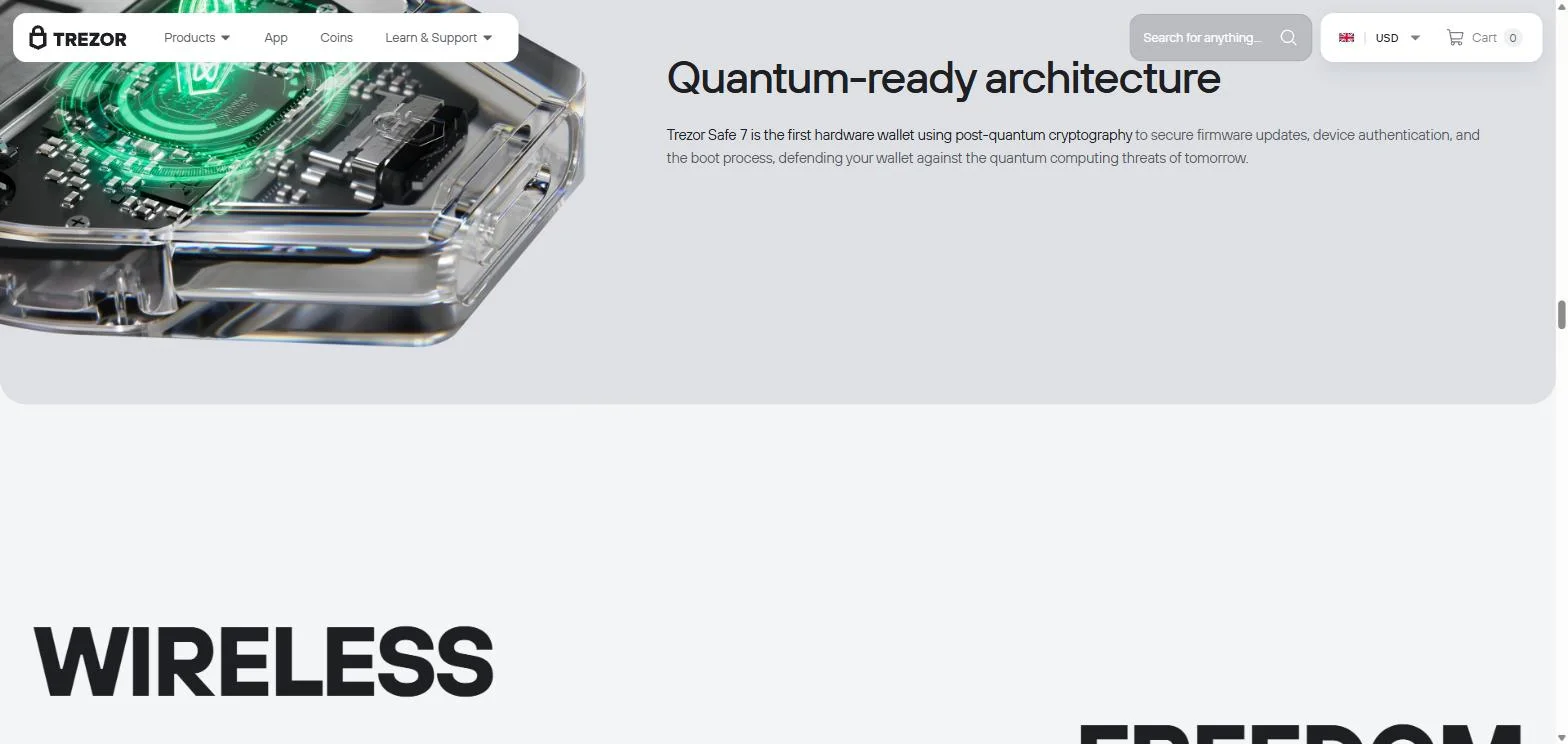
Trezor markets the Trezor Safe 7 as the first hardware wallet using post-quantum cryptography. Read the company's own wording carefully: the scheme secures firmware updates, device authentication and the boot process.
It does not protect your coins.
Bitcoin and Ethereum still sign transactions with elliptic-curve cryptography. No hardware wallet can change that, because the signature scheme is set by the blockchain, not the device. What the Trezor Safe 7 buys you is a device that can receive quantum-secure firmware updates without being replaced, if and when networks adopt post-quantum signatures. That is sensible future-proofing. It is not quantum protection for your holdings today, and a fair number of experienced users have called the framing marketing-led. Both readings are defensible. The specification is what it is.
Bluetooth, and what it costs you
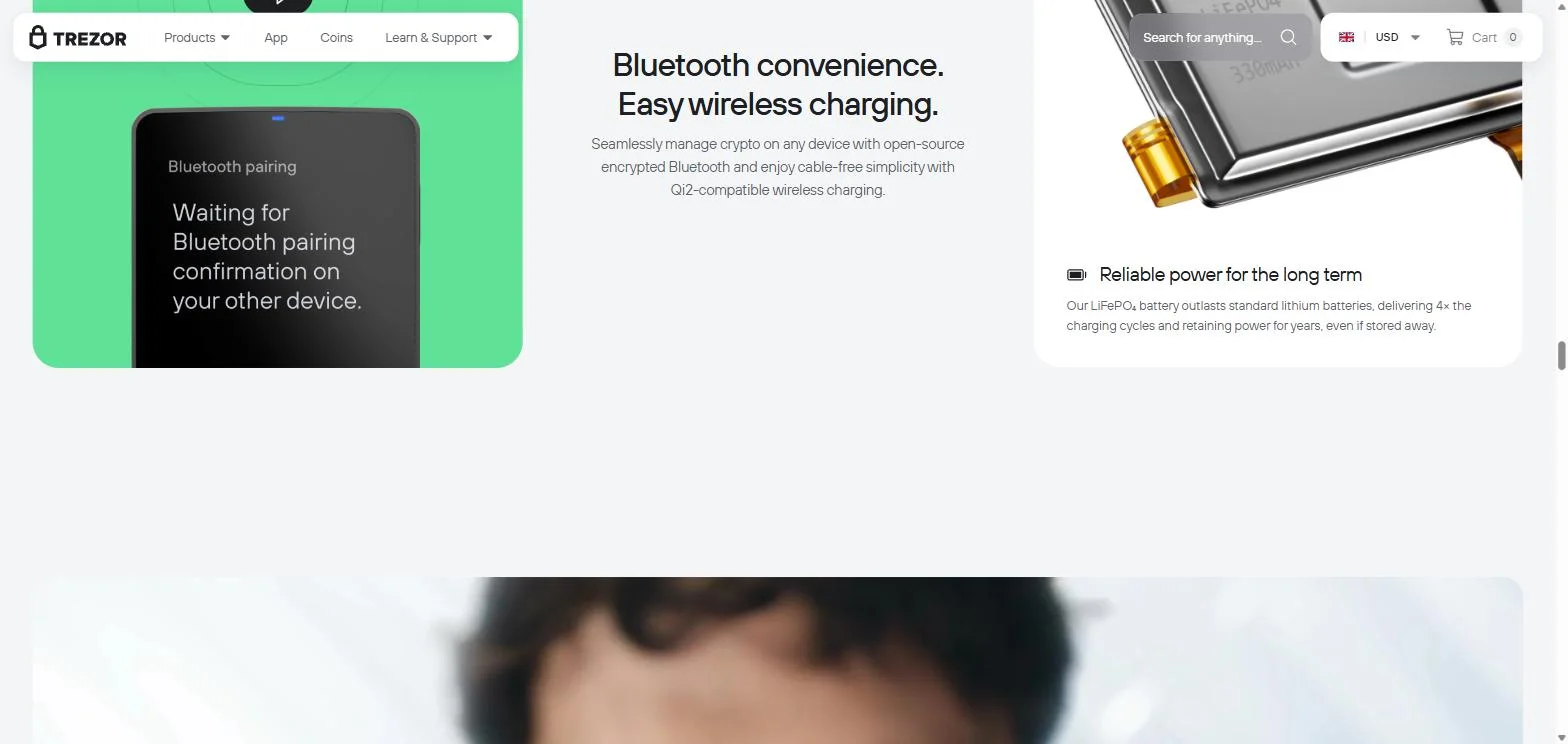
The Trezor Safe 7 pairs over Bluetooth using the open-source Trezor Host Protocol with end-to-end encryption, and Bluetooth can be disabled entirely. Trezor has done the work here properly, with a protocol that is inspectable rather than a proprietary black box.
Still, a radio is a radio. The Trezor Safe 7 is a connected-signing device, not an air-gapped one. If your model of cold storage is that the wallet should never have a live channel to anything, a QR-based air-gapped design such as the Keystone 3 Pro answers that differently, and the Trezor Safe 7 will not satisfy you no matter how good the encryption is. If you value signing on your phone without cables, the trade is reasonable, and you can turn the radio off when you are not using it.
The battery is a wear part
The internal cell is LiFePO4 rather than standard lithium. Trezor claims four times the charge cycles and better long-term retention in storage. If the battery does fail, the device still works over USB-C, which is the right design decision.
But it is not user-replaceable, and this is a product people buy to hold keys for a decade. A sealed battery in a device with that lifespan is a genuine, if modest, structural criticism, and it is one the community raised immediately. The mitigation is real. So is the wear part.
The gap nobody advertises: Monero
Here is a concrete regression that will not appear in any spec comparison. Monero is supported on the Trezor Safe 5, Safe 3 and Model T. On the Trezor Safe 7 it is technically present in firmware, but per Trezor's own knowledge base, Monero is not supported in Trezor Suite and third-party wallet support for the Safe 7 is still pending. In practice, you cannot currently use Monero with a Trezor Safe 7.
If XMR is part of your portfolio, the flagship is at present less capable than the model at half the price. Trezor also warns that its Monero derivation uses SLIP10 rather than standard BIP39 or SLIP39, so a Monero backup may not import cleanly into a non-Trezor wallet.
Buying, returns and warranty
Worth knowing before you order from the official Trezor store: returns are accepted within 15 days of delivery, but only for unopened, sealed items in original condition. An opened device cannot be returned. In the USA and UK, Trezor provides a return label and deducts its cost from the refund. Elsewhere the customer pays return shipping. The warranty runs two years for individual customers and one year for business customers from the date of delivery.
The practical consequence is that you cannot try a Trezor Safe 7 and send it back. Buy it because you have decided you want it, not to compare it in the hand against something else.
Only ever buy from Trezor directly or an authorised reseller. Hardware wallets bought through third-party marketplaces are a well-documented supply-chain risk, and no amount of secure-element engineering helps if the device was tampered with before it reached you.
What the ratings actually tell us
Trezor's own store shows 4.7 out of 5 from 63 reviews, all from verified buyers: 52 five-star, four four-star, five three-star, one two-star and one one-star. That is a good score, and the verified-buyer requirement is better than most vendor review widgets.
It is also 63 reviews, hosted by the seller, on a product that is new. There is no long-term independent reliability data on the Trezor Safe 7 yet, no two-year battery reports and no accumulated failure rates. Early hands-on reviews have been positive on build and setup, with the recurring criticisms being price, the sealed battery, Bluetooth as an added surface, and scepticism about the quantum framing. Treat the 4.7 as an encouraging early signal, not as proof of durability.
Who this is for
The Trezor Safe 7 makes sense if you hold a meaningful position, you want the largest and clearest confirmation screen Trezor has shipped, you sign from a phone often enough that cables genuinely annoy you, and you place real value on the TROPIC01 chip being auditable rather than sealed under an NDA. If that describes you, the current listing and colour options are on Trezor's site.
It makes less sense if you are storing a modest amount, because the Safe 5 at USD 129 carries a certified EAL6+ secure element and protects keys perfectly well. It makes less sense if you hold Monero, which currently does not work. It makes less sense if your requirement is a genuinely air-gapped workflow, or if you were buying primarily on the quantum-ready claim, which does not protect your coins.
If you are new to self-custody, the device is the smaller half of the problem. Backup discipline is what actually loses people money. Read how to set up a self-custody wallet responsibly before you spend anything, and understand what a hardware wallet can and cannot protect you from.
Bottom line
The Trezor Safe 7 is the most interesting hardware wallet the company has built, and the auditable secure element is a real contribution to an industry that has asked users to trust sealed chips for a decade. The irony is that the openness immediately produced a published, unpatchable hardware flaw, which is the open model working, and also a fact you now own if you buy one.
At USD 249 it is a considered purchase rather than a default recommendation. Buy it for the screen, the build and the transparency. Do not buy it for quantum protection you will not get, and do not buy it if you need Monero. Check current pricing and availability on the official Trezor store.
Disclosure: this article contains affiliate links. If you buy through them we may earn a commission at no additional cost to you. This does not affect our assessment, and the criticisms above stand regardless.